

Mathematics5 min read
Equilateral Triangles: The Perfect Triangle Explained
Discover the equilateral triangle - the perfect triangle with equal sides and angles. Learn its properties, formulas, and real-world applications in geometry.
Calculate all properties from just one measurement. Perfect symmetry - all sides equal, all angles 60°
Properties
All sides equal • All angles = 60°
Enter one value to calculate all properties
Side Length
-
Height
-
Area
-
Perimeter
-
Inradius
-
Circumradius
-
An equilateral triangle is the most symmetric type of triangle, with all three sides equal in length and all three angles measuring exactly 60°. This perfect symmetry makes equilateral triangles particularly elegant mathematically and useful in design, engineering, and nature. You can explore more about equilateral triangle properties at Wolfram MathWorld for deeper mathematical insights. From honeycomb patterns to architectural structures, equilateral triangles appear wherever maximum strength and efficiency are needed.
The defining characteristic of an equilateral triangle is that all three sides are equal in length. This immediately implies that all three angles are also equal, and since the sum of angles in any triangle is 180°, each angle must be 180° ÷ 3 = 60°. This makes the equilateral triangle both equilateral (equal sides) and equiangular (equal angles).
Essential Formulas:
Height = side × √3/2
Area = (√3/4) × side²
Perimeter = 3 × side
Inradius = side × √3/6
Circumradius = side × √3/3
For a complete breakdown, see equilateral triangle formulas explained at Cuemath.
| Quantity | Formula | Approx. (in terms of a) |
|---|---|---|
| Perimeter (P) | P = 3a | 3.000 × a |
| Semiperimeter (s) | s = 3a/2 | 1.500 × a |
| Height (h) | h = a√3/2 | 0.866 × a |
| Area (A) | A = (√3/4) × a² | 0.433 × a² |
| Inradius (r) | r = a√3/6 | 0.289 × a |
| Circumradius (R) | R = a√3/3 | 0.577 × a |
Notice that R is exactly twice r — this 2:1 ratio is unique to the equilateral triangle and confirms that all four "centers" of the triangle (centroid, circumcenter, incenter, and orthocenter) coincide at the same point.
Drop a perpendicular from one vertex to the opposite side. By symmetry, it bisects the base into two segments of length a/2. The perpendicular itself has length h, and the equal side a is the hypotenuse of the right triangle that's formed.
Then Area = ½ × base × height = ½ × a × (a√3/2) = (√3/4) × a². ✓
Use the SAS area formula: Area = ½ × a × b × sin(C). For an equilateral triangle, all sides equal a and the included angle is 60°.
A US road yield sign is an equilateral triangle with a side of 36 inches. Find its area, height, and perimeter.
An equilateral triangle has area 50 cm². What is the side length?
Verify: enter 50 in the Area field above.
A decorative tile has an equilateral triangular face with a height of 5 inches. What is the side?
Every equilateral triangle hides a pair of 30-60-90 right triangles inside it. When you draw an altitude from any vertex to the opposite side, the altitude bisects both that side and the apex angle (60° splits into two 30° angles). The result is two congruent 30-60-90 special right triangles, each with:
This is why the 1 : √3 : 2 ratio of 30-60-90 triangles shows up everywhere in equilateral triangle math — it's the same geometry, just split in half.
Equilateral triangles have three lines of symmetry, each passing through a vertex and the midpoint of the opposite side. These lines of symmetry are also the altitudes, medians, angle bisectors, and perpendicular bisectors - all four of these traditionally different lines coincide in an equilateral triangle. The point where all three lines meet is called the centroid, and it's also the circumcenter, incenter, and orthocenter all at once.
The height of an equilateral triangle is always √3/2 times the side length (approximately 0.866 times the side). This ratio comes from the 30-60-90 triangle formed when you draw the height, which splits the equilateral triangle into two mirror-image 30-60-90 triangles.
Structural Engineering: Equilateral triangles are incredibly strong and rigid. Unlike squares or rectangles that can collapse into parallelograms under pressure, triangles maintain their shape. Equilateral triangles distribute stress evenly across all three sides, making them ideal for trusses, bridges, and tower structures like the Eiffel Tower.
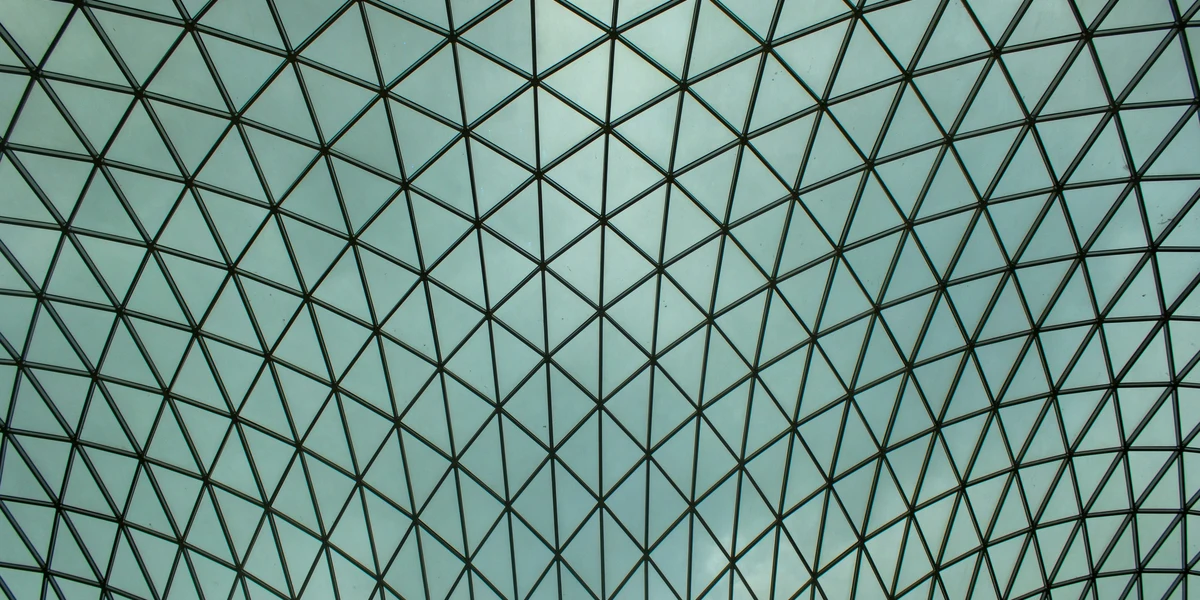
Tessellation and Tiling: Equilateral triangles can tile a plane perfectly with no gaps or overlaps. Six equilateral triangles meet at each vertex, and this pattern is found in floor tiles, quilts, and molecular structures. When combined with hexagons (which are made of six equilateral triangles), they create even more complex tessellation patterns.
Nature and Chemistry: Hexagonal patterns in honeycombs are composed of equilateral triangles. Many molecular structures, particularly in chemistry and crystallography, feature equilateral triangle arrangements because they maximize space efficiency while minimizing material use. This is why soap bubbles form hexagonal patterns when packed together.
Use the formula Area = (√3/4) × a², where a is the side length. For example, a triangle with side 6 has area (√3/4) × 36 ≈ 15.59 square units. You can also use the standard ½ × base × height formula with height = a√3/2 — both give the same answer.
Area = (√3 / 4) × a². For example, an equilateral triangle with a side of 6 has an area of (√3/4) × 36 ≈ 15.59 square units. The constant √3/4 ≈ 0.4330.
Three equal sides; three equal angles (60° each); three lines of symmetry; the centroid, orthocenter, incenter, and circumcenter all coincide at the same point; the height equals a√3/2; and area equals (√3/4)a². It is the most symmetric of all triangles.
A triangle is equilateral when all three sides are exactly equal in length. This automatically forces all three angles to be 60° each, since equal sides imply equal opposite angles and the three angles must sum to 180°.
No. In an equilateral triangle, all angles are 60°. A right triangle must have one 90° angle, so the two types are mutually exclusive.
Yes. Isosceles only requires at least two equal sides — equilateral triangles have three equal sides, so they automatically meet that condition. Every equilateral triangle is isosceles, but most isosceles triangles are not equilateral.
Isosceles triangles have at least two equal sides, while equilateral triangles have all three sides equal. All equilateral triangles are isosceles, but not vice versa.
The inradius is the radius of the largest circle that fits inside the triangle (touching all three sides). The circumradius is the radius of the circle that passes through all three vertices. For an equilateral triangle: inradius = a√3/6 and circumradius = a√3/3 — the circumradius is exactly twice the inradius.
When you drop a perpendicular from any vertex to the opposite side, it bisects the base and creates two 30-60-90 right triangles. In a 30-60-90 triangle the long leg (height) equals the hypotenuse times √3/2. Pythagorean theorem confirms: h² + (a/2)² = a², so h = (a/2)√3.
Drop the altitude h from the apex; it has length a√3/2 (from Pythagoras). Then Area = ½ × base × height = ½ × a × (a√3/2) = (√3/4) × a². You can also derive it trigonometrically: Area = ½ × a × a × sin(60°) = ½ × a² × (√3/2) = (√3/4) × a². Same answer two ways.
Deepen your understanding of triangles and trigonometry with our guides and tutorials:
Discover the equilateral triangle - the perfect triangle with equal sides and angles. Learn its properties, formulas, and real-world applications in geometry.
Master special right triangles with ratio shortcuts and memory tricks. Learn 30-60-90 (1:√3:2) and 45-45-90 (1:1:√2) patterns for quick calculations.

Discover Pythagorean triples - right triangles with whole number sides. Learn common triples (3-4-5, 5-12-13) and Euclid's formula to generate more.

Discover why triangles are the strongest shape in engineering and construction. Learn how this geometric principle powers cranes, bridges, and iconic structures.

Learn 5 proven methods to calculate triangle area with step-by-step examples. Master geometry formulas for homework, construction, and real-world applications.

Master the Law of Sines to solve any oblique triangle! Learn when and how to use this powerful trigonometry tool with step-by-step examples and practice problems.
Formulas and results last reviewed . How we check accuracy · Corrections log · Report an error