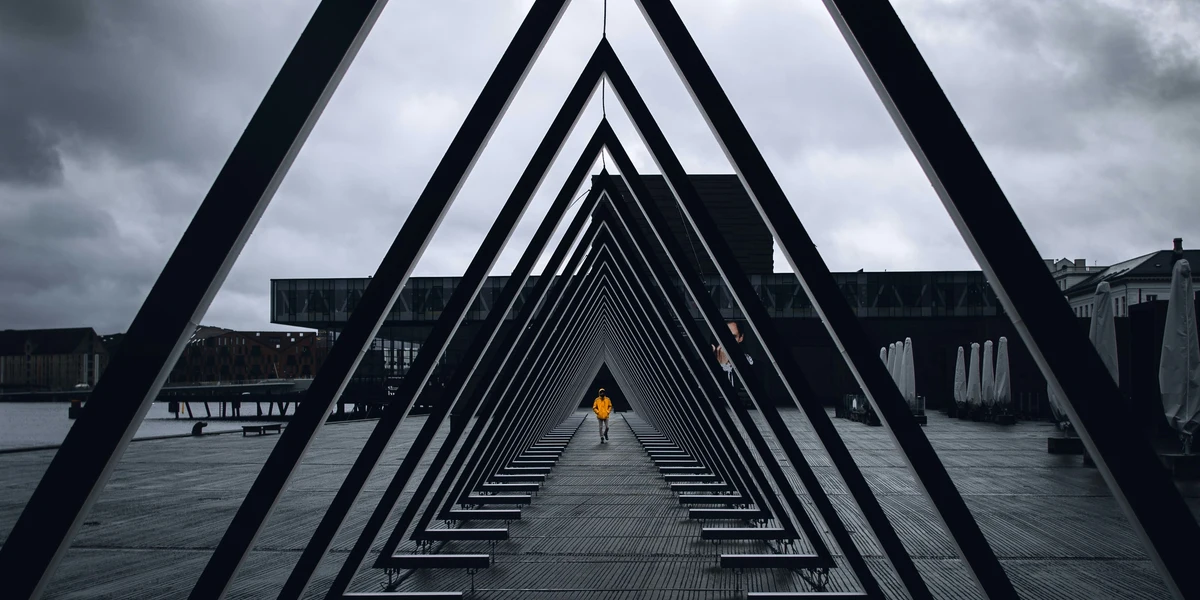
Why Are Triangles the Strongest Shape? The Engineering Secret Hidden in Geometry
Triangles are the strongest shape in engineering: three fixed sides lock the angles. The geometry, a worked force example, and how trusses use it.
Trigonometry at work: stair stringers, roof pitch, ladder angles, woodworking, surveying, truss strength, video games and wilderness navigation.
10 articles
Triangles are the strongest shape in engineering: three fixed sides lock the angles. The geometry, a worked force example, and how trusses use it.
Geometry you use without realizing it: the math behind mirror height, curves, monitor angles, pizza slices, ladder placement and moving a couch.
How geometry and woodworking go hand in hand: miter angles, frame cut lengths, squaring with 3-4-5 and diagonals, dovetail ratios and the jigs for them.
How to calculate stair stringers: riser count, unit rise and run, stringer length and stair angle, with IRC limits and a worked 48-inch deck stair.
How trigonometry brings video games to life: the sine, cosine, arctangent and distance math behind movement, rotation, projectiles, cameras and lighting.
Wilderness survival math: find direction with a shadow stick or watch, measure distance by pace count, and fix your position with compass bearings.
How to calculate roof pitch: tan(angle) = rise ÷ run, so a 6/12 roof is 26.57°. Pitch-to-angle conversions, rafter length, code minimums, a worked example.
Trigonometry for DIY home projects with worked numbers: 3-4-5 deck squaring, stair stringers, attic knee walls, ramps, crown molding cuts and gate braces.
The 4-to-1 ladder rule: 1 foot out for every 4 feet up sets a ladder at about 76°. The trig behind it, OSHA's version, placement examples, tipping risks.
Surveying with trigonometry: measure heights and distances you can't reach using right triangles, angle of elevation, tangent and the two-position method.